Nature and heart health
Spending just two hours in nature each week can help improve your heart health!
Nature allows us to switch off from the pressures of everyday life.
In urban environments, green and blue spaces (vegetation and water) can provide opportunities for play, rest, socialising and being physically active. Beyond urban environments, nature provides a mental break from the visual complexity, noise, intensity and constant movement.
Spending time in nature is an affordable, effective preventive health strategy. It's no to low cost, has minimal risk or side effects, and requires no special equipment or training needs.
Find nature near you
You don’t need to travel long distances to a forest or a national park. You can find a local park close to you using our interactive community walkability map.
Find out more
There are some key actions that we can all take to improve connection with nature for heart health:
For built environment industry practitioners:
Greening urban environments is a powerful, cost-effective and inexpensive public health intervention
For healthcare providers:
Nature-based social prescriptions offer low risk, affordable, effective preventive health treatment.
For community:
Spending two hours in nature each week is a great way to be physically active and socially connected.
Context
Humans have an innate connection with the natural world. 1 2 For most of human history we have evolved and lived with the outdoor world, in natural settings. 3
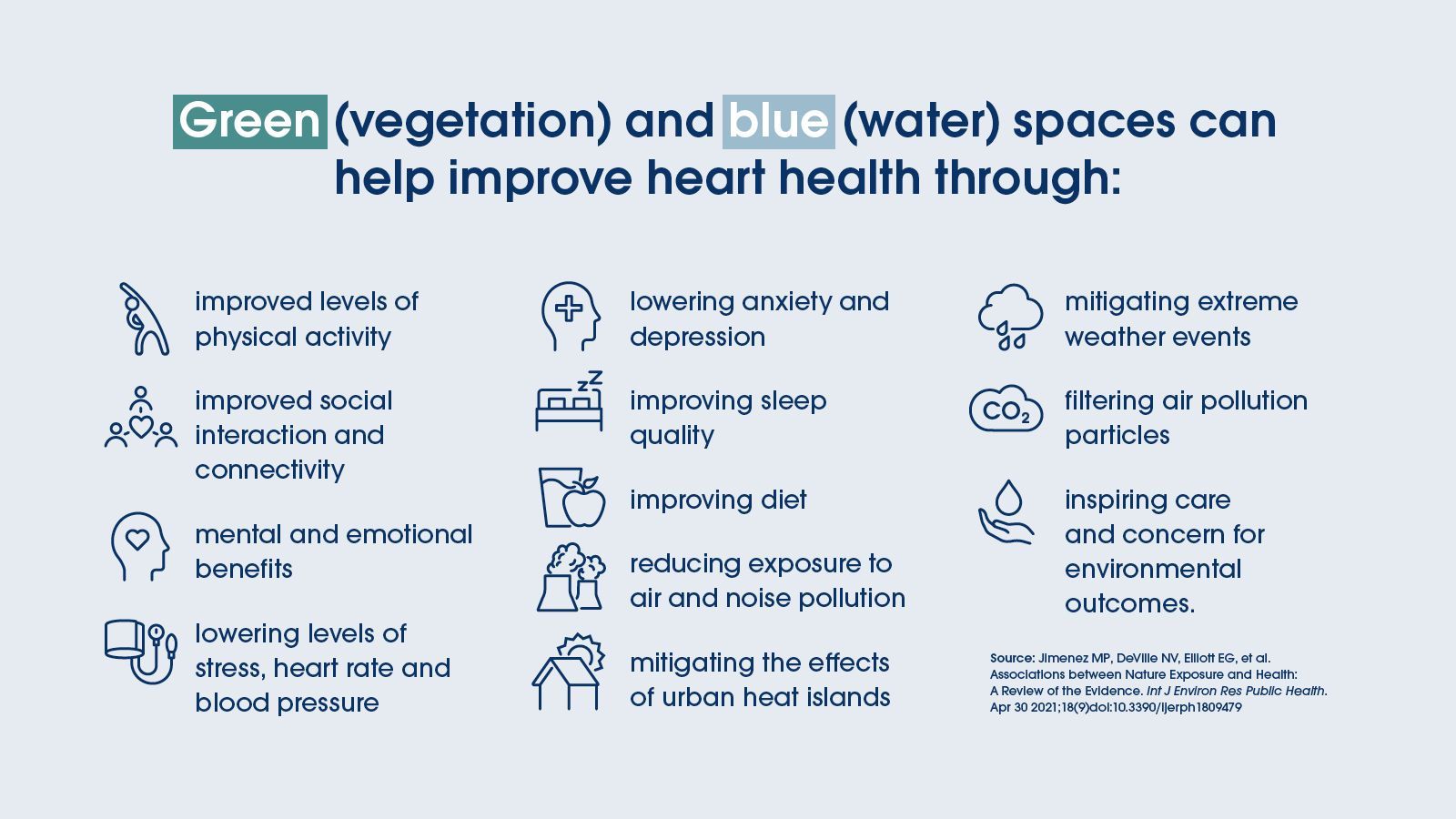
This connection is important for both human and planetary health. 4 Spending time in nature can help lower levels of stress (cortisol), blood pressure and heart rate, and provide opportunities for physical activity and social connection. 5 1 It can also lead to increased care and concern for the environment. 6
However, we are becoming increasingly disconnected from nature. ‘Nature deficit disorder’ is a term used to describe the concept of this disconnection on our health and wellbeing. 7 Poor cardiovascular health is one of many concerns linked to lack of exposure to nature. 8 Where time is not spent in nature, a person does not receive health-mitigating effects to help reduce stress, blood pressure and heart rate, among other benefits.
To turn this around, we need to make nature more available, easier to access, and part of people’s everyday lives. This includes access to green (vegetation) and blue (water) spaces in built and natural environments. Examples in built environments include public open spaces, tree canopy, community gardens, and vertical green walls. Natural environments include forests, mountains, rivers, and coastal environments.
Research shows that spending at least two hours each week in nature provides a wide range of health benefits. 9 Benefits include improved brain function and mental health, and lower blood pressure, heart rate, and cortisol levels. 1
There are many actions we can all take as built environment industry practitioners, healthcare providers, and community members to improve access and connection to nature.
Physical activity in nature
Research shows that exercising outdoors can have a greater health benefit than exercising indoors. 3 People may exercise more often and for longer periods of time in natural environments. 3 Appealing and enjoyable spaces can increase motivation and lower levels of perceived effort. 3 Time spent walking in a forest can have additional health benefits compared to walking in an urban area. 19
The quality of green and blue spaces where we spend time outdoors is also important: areas with higher levels of biodiversity tend to deliver greater health benefits. 20
Social connection in nature
In addition to physical activity, social connection is also important for heart health. 10 Nature-based environments provide opportunities for social interaction that may not be achieved in other settings. 1 3 This includes outdoor-specific activities such as picnics and other social gatherings, as well as being able to focus more on family and friends in natural settings. 11 12
You can find out more through our fact sheet on walkability, social connection and heart health.
Built environments
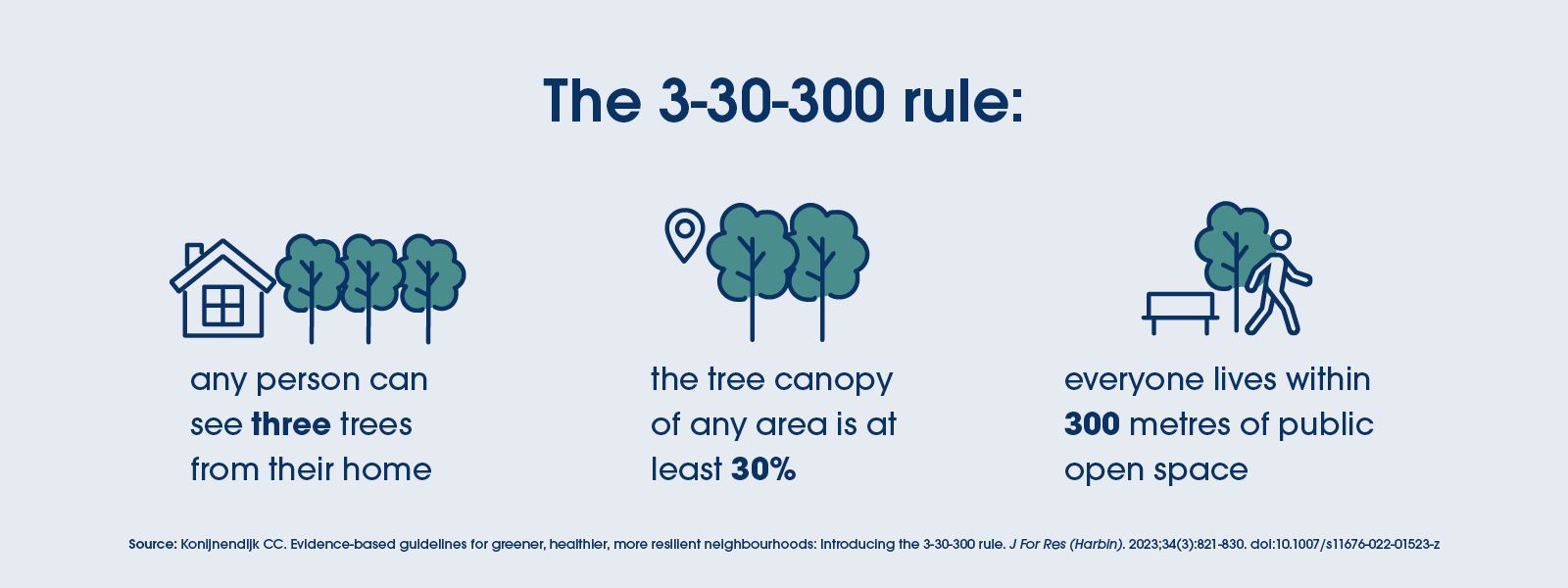
To ensure all people living in Australia benefit from time spent in nature, all urban environments should provide green and blue spaces. While implementation can be complex, there are many small actions that can be taken. Our built environment industry practitioner flyer, below, provides guidance.
Studies have found a strong link between the cardiovascular health of people who live in walkable urban environments with higher amounts of green space. 13 These areas often tend to be older, established neighbourhoods. 14
In contrast, less advantaged areas and areas of high urban density often have less availability of, and access, to green and blue spaces. 15 16 17 13 18
Everyone in Australia should be able to access and meaningfully connect with nature as part of everyday life.
You can find out more through our fact sheet on green and blue spaces in urban environments.
Natural environments
Spending time in nature exposes us to a range of microbiota and other chemical and biological organisms. 19 This is thought to be beneficial for health because of the response it produces in our parasympathetic nervous system. This response includes helping reduce and manage levels of stress 1 and improving blood pressure. 19 Forested and mountainous areas, and flowing rivers have high concentrations of negative air ions. 21 This can help reduce anxiety and depression. 8,19
Natural environments also provide opportunities to experience moments of awe (something larger than ourselves). These moments can also provide health benefits.
19
Priority populations
Physical activity in green and blue spaces can benefit the health of older people. Examples include community gardening, 22 increased opportunities for walking 18 23 and use of outdoor exercise equipment. Volunteer-led activities enhance these benefits. 24 25
The natural environment is often cited as a major asset for physical activity, particularly walking, in rural and regional areas. 26
LQBTQIA+ people are less likely than other groups to meet physical activity guidelines. 27 One research study in regional Victoria found that when people from this group do take part in physical activity, they are more likely to do so through hiking/bushwalking and in natural settings. These environments are perceived to be more welcoming and inclusive. 28
Environmental behaviours
Spending time in nature can help people connect with and care about the environment. 4 6 29 It can build empathy for the natural world and encourage positive behaviour. This can include actions such as reducing waste, reusing items, and recycling.
These behaviours can help reduce the impacts of climate change. Addressing climate change—such as lowering air pollution and reducing extreme weather—can further benefit heart health. 30 Together, this creates a positive cycle that supports both environmental and human health. You can find out more about the impacts of climate change on heart health here.
Physical Activity in Nature
for cardiometabolic Diseases
in people Aged 45y+
The PANDA Trial is a study designed to increase physical activity for people with cardiometabolic diseases aged 45years plus.
Find out more about the
heart-mind connection
Poor mental health can contribute to development of heart disease,
and impact recovery from a heart event. Social connection in nature can help.
References
1. Jimenez MP, DeVille NV, Elliott EG, et al. Associations between Nature Exposure and Health: A Review of the Evidence. Int J Environ Res Public Health. 2021; doi:10.3390/ijerph18094790
2. Wilson EO. Biophilia - the human bond with other species. Harvard University Press; 1984.
3. Gladwell VF, Brown DK, Wood C, Sandercock GR, Barton JL. The great outdoors: how a green exercise environment can benefit all. Extrem Physiol Med. Jan 3 2013;2(1):3. doi:10.1186/2046-7648-2-3
4. Sollis K, Rajeevan U, van Eeden LM, et al. Connecting with nature: The missing link between a satisfied life and a healthy life? Ambio. 2026; doi:10.1007/s13280-025-02325-3
5. Al Ghanim S, Kaleta B, Campbell S, O'Keeffe J, Burke J. Nature's heart: a scoping review of the impact of nature-based interventions for cardiovascular and metabolic disease. J Public Health (Oxf). 2025. doi:10.1093/pubmed/fdaf074
6. Liu Y, Cleary A, Fielding KS, Murray Z, Roiko A. Nature connection, pro-environmental behaviours and wellbeing: Understanding the mediating role of nature contact. Landscape and Urban Planning. 2022. doi:https://doi.org/10.1016/j.landurbplan.2022.104550
7. Louv R. Last Child in the Woods - Saving Our Children from Nature-Deficit Disorder. Algonquin; 2008.
8. Browning M, Hanley JR, Bailey CR, et al. Quantifying Nature: Introducing NatureScore(TM) and NatureDose(TM) as Health Analysis and Promotion Tools. Am J Health Promot. 2024. doi:10.1177/08901171231210806b
9. White MP, Alcock I, Grellier J, et al. Spending at least 120 minutes a week in nature is associated with good health and wellbeing. Scientific Reports. 2019. doi:10.1038/s41598-019-44097-3
10. Yang Z, Liu C, He L, et al. Social isolation and loneliness increase the risk of coronary heart disease: Insights from a prospective cohort study. Social Science & Medicine. 2025. doi:https://doi.org/10.1016/j.socscimed.2025.117701
11. Jennings V, Bamkole O. The Relationship between Social Cohesion and Urban Green Space: An Avenue for Health Promotion. Int J Environ Res Public Health. 2019; doi:10.3390/ijerph16030452
12. Henderson L, Tipper L, Willicombe S, Gattis M. Shared time in nature increases feelings of social connection amongst university students. Journal of Environmental Psychology. 2024. doi:https://doi.org/10.1016/j.jenvp.2024.102343
13. Makram OM, Nwana N, Pan A, et al. Interplay Between Residential Nature Exposure and Walkability and Their Association with Cardiovascular Health. JACC: Advances. 2025. doi:https://doi.org/10.1016/j.jacadv.2024.101457
14. Marcos Martinez R, Soonsawad N, Dias Baptista M, et al. Challenges and strategies in meeting urban tree canopy targets: A scenario discovery analysis to guide urban forest planning in new developments. Trees, Forests and People. 2025. doi:https://doi.org/10.1016/j.tfp.2025.100787
15. Wood S, Vasey, T., Carroll, S., . Supporting active living in neighbourhoods of lower socioeconomic advantage. 2024. Report prepared for the National Heart Foundation of Australia.
16. Astell-Burt T, Feng X, Mavoa S, Badland HM, Giles-Corti B. Do low-income neighbourhoods have the least green space? A cross-sectional study of Australia’s most populous cities. BMC Public Health. 2014. doi:10.1186/1471-2458-14-292
17. Foster S, Kleeman, A., Lowe, M., Gunn, L., De Gruyter, C., Chandrabose, M., Alderton, A., Villanueva, K., Edwards, N., Mandzufas, J., Rachele, J. N., Reid, R., Astell-Burt, T., Feng, X., Owen, N., Giles-Corti, B. Designing for Density - Delivering healthy, higher-density neighbourhoods in Australia. 2025. Report prepared for the National Heart Foundation of Australia.
18. Chandrabose M, Gunn, L., Astell-Burt, T., Badland, H., Carver, A., Christian, H., Cleland, V., Edwards, N., Feng, X., Loh, V., Owen, N., Rachele, J., Sugiyama, T., Timperio, A., Veitch, J. Walkability and the built environment. 2026. Report prepared for the National Heart Foundation of Australia.
19. Kuo M. How might contact with nature promote human health? Promising mechanisms and a possible central pathway. Front Psychol. 2015. doi:10.3389/fpsyg.2015.01093
20. Wyles K, White M, Hattam C, Pahl S, King H, Austen M. Are Some Natural Environments More Psychologically Beneficial Than Others? The Importance of Type and Quality on Connectedness to Nature and Psychological Restoration. Environment and Behavior. 2017. doi:10.1177/0013916517738312
21. Stanhope J, Foley K, Butler M, et al. Australian allied health professionals' perspectives on current practice, benefits, challenges, and opportunities in nature-based approaches. Health & Place. 2025. doi:https://doi.org/10.1016/j.healthplace.2025.103430
22. Boffi M, Pola L, Fumagalli N, Fermani E, Senes G, Inghilleri P. Nature Experiences of Older People for Active Ageing: An Interdisciplinary Approach to the Co-Design of Community Gardens. Front Psychol. 2021. doi:10.3389/fpsyg.2021.702525
23. Chandrabose M, Hadgraft N, Owen N, Mavoa S, Sugiyama T. Joint associations of neighbourhood walkability and greenery with walking among middle-aged and older adults: Findings from diverse urban settings in Australia. Health & Place. 2024. doi:https://doi.org/10.1016/j.healthplace.2024.103334
24. Levinger P, Dreher B, Fearn M, Hill KD. Successful Implementation and Sustainability of a Physical Activity Health Promotion Approach Utilising Community Peer-Led Training: Case Studies of Two Local Governments in Victoria. Health Promot J Austr. 2025. doi:10.1002/hpja.70005
25. Levinger P, Dunn J, Abfalter E, et al. The ENJOY MAP for HEALTH: Exercise interveNtion outdoor proJect in the cOmmunitY for older people—More Active People for HEALTHier communities: a study protocol. BMC Public Health. 2022. doi:10.1186/s12889-022-13335-1
26. Galvin L. C, V., Jose, K., Stanesby, O. Love your heart, Love your community, A citizen science research project using the Heart Foundation's Community Walkability Checklist. 2026. University of Tasmania, Menzies Research Institute.
27. De Silva C, Ridgers ND, Mazzoli E, O’ Loughlin NM, Barnett LM. A systematic review of correlates of physical activity of LGBTQIA+ people. Journal of Sports Sciences. 2026. doi:10.1080/02640414.2026.2623566
28. De Silva C, Mazzoli E, Ridgers ND, Barnett LM. Physical activity and active recreation practices of LGBTQIA+ individuals in regional and rural Australia: A cross-sectional analysis of 17,398 residents. Journal of Science and Medicine in Sport. 2026;doi:10.1016/j.jsams.2026.04.015
29. Lin BB, Sollis K, Flies EJ, Marsh P. Nature connection, wellbeing and pro-environmental behaviour across an urban gradient: Understanding the regional sweet spot. Ambio. 2026. doi:10.1007/s13280-025-02229-2
30. Australian Government, Aistralian Institute of Health and Welfare. Natural environment and health. Accessed 27/2/2026, https://www.aihw.gov.au/reports/australias-health/natural-environment-and-health
Terms of use: This material has been developed by the National Heart Foundation of Australia (Heart Foundation) for general information and educational purposes only. It does not constitute medical advice. Please consult your healthcare provider if you have, or suspect you have, a health problem. The information provided is based on evidence available at the time of publication. Please refer to the Heart Foundation website at www.heartfoundation.org.au for Terms of Use.
Disclaimer and Limitation of Liability: The Heart Foundation makes no representation or warranty that the information provided in these resources is accurate, complete, or up-to-date, nor that it is suitable for your particular circumstances. Any use of these resources is entirely at your own risk. If you have any queries or concerns about the information on this website you should seek your own independent advice and always follow the advice of your medical professional regarding walking and your activity levels. To the fullest extent permitted by law, the National Heart Foundation of Australia, its officers, and employees shall not be liable for any loss, damage, or injury arising from your reliance on the information provided. In an emergency or if you identify a safety hazard, please contact triple-zero (000) immediately.
Important Safety and Reporting Notice:
- Safety Reporting: If you discover any safety hazards while walking, please report these directly to your local council as soon as possible. The Heart Foundation does not provide a report on safety hazards or incidents to your local council.
- General Guidance: The information provided is for general guidance only and is not intended to replace professional advice or local council requirements. If you have trouble with physical activity, we advise that you seek advice from a medical or health professional to determine if walking is suitable for you. Only walk if you feel it's safe to do so. This can include consideration of the time of day, weather, heat and other factors.